Yellowstone’s Wild Soul: Where Nature Meets Art in Full Immersion
You know that feeling when art doesn’t just hang on a wall but surrounds you? That’s Yellowstone. I’m not talking about galleries—I mean geysers painting the sky, bison tracing ancient patterns across golden meadows, and sunsets that look like they were brushed by some unseen master. This park isn’t just a destination; it’s a living canvas. Immersing yourself here isn’t just travel—it’s transformation. Let me show you how art and nature become one in America’s oldest wilderness.
The Living Art of Yellowstone’s Landscapes
Yellowstone National Park is often described in geological terms—supervolcanoes, hydrothermal basins, seismic activity—but its true power lies in its artistic expression. The land itself behaves like a master painter, using time, heat, and water to craft ever-evolving masterpieces. Old Faithful, perhaps the most iconic geyser in the world, erupts with rhythmic precision, sending plumes of steam and water skyward as if sketching temporary sculptures in vapor. Each burst is unique, shaped by subtle shifts in underground pressure and mineral composition, making every viewing an original performance.
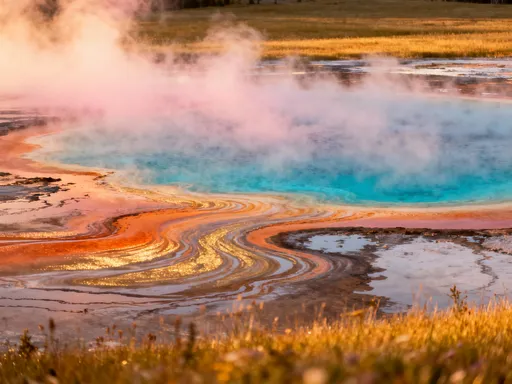
Equally breathtaking is the Grand Prismatic Spring, a vast thermal pool that radiates color in concentric rings. Blues at the center—caused by extreme heat and pure water—give way to emerald greens, then golden yellows, and finally deep reds and oranges at the cooler edges. These hues are not pigments but living pigments: heat-loving microorganisms called thermophiles that thrive in specific temperature zones. The result is a natural mandala, a biological painting that changes slightly with the seasons, sunlight, and microbial growth cycles. To stand above it on the boardwalk is to gaze into a living kaleidoscope, one that no human hand could replicate.
The Yellowstone River adds another dimension to this artistic narrative. Carving through canyons and meandering across valleys, it sculpts the land with patient persistence. The Lower Falls of the Yellowstone plunges 308 feet into the Grand Canyon of the Yellowstone, creating a thunderous display of power and grace. The canyon walls, stained yellow and red by oxidized iron in the rhyolite rock, glow under morning light like a fresco from an ancient temple. These natural formations are not static; they are in constant conversation with time, water, and heat. Experiencing them in person—feeling the mist on your face, hearing the roar, smelling the sulfur in the air—creates a depth of connection that no photograph or video can fully convey.
There is a reason why visitors often fall silent when they first see these wonders. It is not merely awe at their scale, but recognition of their artistry. The park does not display nature—it performs it. And when you witness these phenomena firsthand, you become part of the audience in a grand, ongoing exhibition that has been running for millennia.
Indigenous Cultures and Timeless Expressions
Beyond the geysers and canyons, Yellowstone’s artistic soul is deeply rooted in human history. For over 11,000 years, Native American tribes—including the Shoshone, Bannock, Crow, Blackfeet, and others—have lived in and traveled through this region, forming spiritual, cultural, and practical relationships with the land. Their presence predates the park’s establishment in 1872, and their traditions continue to enrich the visitor experience today through storytelling, craftsmanship, and cultural preservation.
Many of these tribes viewed the geothermal features not as curiosities but as sacred places. The bubbling mud pots, steaming vents, and erupting geysers were seen as manifestations of the earth’s breath, expressions of spiritual power. Oral histories passed down through generations speak of these sites as places of vision, healing, and reverence. The Shoshone, for example, have stories of ancestral beings emerging from thermal areas, shaping the landscape and teaching survival skills. These narratives are not myths in the fictional sense, but frameworks for understanding the world, deeply interwoven with the rhythms of nature.
Visitors can engage with this living heritage through interpretive centers such as the Museum of the National Park Ranger at Norris Junction and the visitor center at Grant Village, where exhibits highlight Native American tools, clothing, and artwork. Beadwork on display—featuring intricate geometric patterns and symbolic colors—reflects both aesthetic mastery and cultural identity. Each bead, carefully placed, tells a story of resilience, connection, and beauty. These creations are not souvenirs; they are testaments to a worldview in which art and life are inseparable.
Respectful engagement is essential. While some cultural ceremonies are private and not open to the public, ranger-led talks and partnerships with tribal historians offer meaningful opportunities to learn. The park’s collaboration with the Eastern Shoshone and Northern Arapaho tribes on educational programs ensures that Indigenous voices are heard and honored. By listening, observing, and learning, visitors do more than appreciate art—they participate in a dialogue that spans centuries.
Photography as Immersive Art
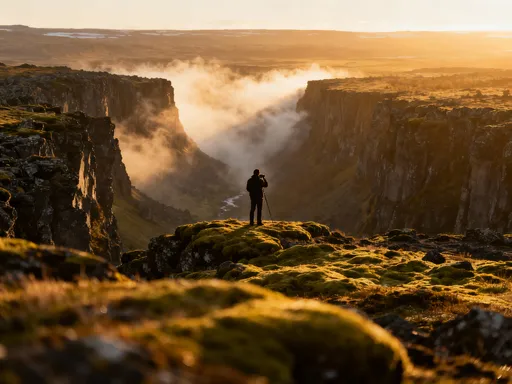
In an age of instant images, photography in Yellowstone becomes more than documentation—it becomes a meditative act of seeing. When you raise your camera not to capture a trophy shot but to truly observe, you slow down. You notice the way light filters through morning fog on Yellowstone Lake, turning the water into liquid silver. You wait for the perfect moment when a bull elk lifts its antlers against a crimson dawn in Lamar Valley. You frame the reflection of a thermal pool so precisely that the boundary between earth and sky dissolves.
The park offers endless opportunities for visual storytelling. The golden hour—just after sunrise and before sunset—transforms ordinary scenes into extraordinary compositions. At Mammoth Hot Springs, the terraced travertine formations glow amber and ivory when struck by low-angle light, their delicate edges softened by shadows. In Hayden Valley, bison herds move like brushstrokes across the grassland, their silhouettes stark against the horizon. Even the steam rising from a fumarole can be captured as a wispy line drawing in the air.
But the real artistry lies not in the gear or settings, but in the practice of presence. To compose a photograph thoughtfully is to engage all your senses. You feel the cold metal of the tripod, hear the shutter click, smell the damp earth after rain. You learn to anticipate animal behavior, to read weather patterns, to wait. In doing so, you move from observer to participant. The camera becomes a tool not for possession, but for connection.
For those new to photography, the park offers accessible entry points. Many overlooks and boardwalks are designed with sightlines that naturally guide the eye toward compelling compositions. Rangers often host informal talks on ethical wildlife photography, emphasizing the importance of distance, patience, and respect for animals. Whether using a smartphone or a DSLR, the goal remains the same: to translate the ineffable beauty of the moment into a lasting impression, not just for others, but for yourself.
The Soundtrack of the Wild: Nature’s Hidden Performance
While much attention is given to what Yellowstone looks like, far less is said about what it sounds like—and yet, sound is an essential part of its artistic fabric. The park is alive with a natural symphony, a layered composition that shifts with the time of day and season. At dawn, the chorus of songbirds—robins, jays, and warblers—fills the air with bright, staccato notes. By midday, the wind takes over, rustling through stands of lodgepole pine with a hushed, whispering rhythm. At dusk, the haunting howl of a wolf pack echoes across the valleys, a sound so primal it seems to rise from the earth itself.
Thermal features contribute their own sonic palette. The constant bubbling of mud pots in the Artists Paint Pots basin creates a gurgling, percussive beat, while steam vents hiss like distant kettles. In the Fountain Paint Pot area, the ground trembles slightly with each eruption, adding a tactile dimension to the auditory experience. These are not random noises, but a structured soundscape—one that has remained largely unchanged for thousands of years.
To truly hear Yellowstone, one must practice deep listening. This means stepping away from roads and crowds, turning off devices, and sitting quietly. A morning walk along the Fairy Falls Trail, for example, offers a gradual immersion into natural acoustics. First, the crunch of gravel underfoot fades as you enter the forest. Then, the distant roar of the falls grows louder, blending with bird calls and insect hum. If you pause and close your eyes, the layers reveal themselves: water, wind, wildlife, earth.
Nighttime offers perhaps the most profound auditory experiences. Far from city lights, the darkness amplifies sound. A coyote’s yip carries for miles. The crack of a branch in the underbrush signals unseen movement. The silence between sounds becomes as meaningful as the sounds themselves. For those willing to sit still, these moments offer a rare form of intimacy with the wild—a reminder that art is not only seen but felt and heard.
Art-Inspired Itineraries: Designing an Aesthetic Journey
Most visitors follow the main loop roads, hitting major attractions in a predictable sequence. But for those seeking a deeper, more artistic engagement, Yellowstone offers quieter pathways—routes designed not for checklist tourism, but for sensory immersion. Three distinct itineraries can transform a standard visit into a curated aesthetic journey, each tailored to a different mode of creative perception.
The first, ideal for painters and visual artists, is a sunrise-to-sunset loop focused on light and color. Begin at Dunraven Pass at dawn, where the rising sun spills over the Yellowstone Caldera, painting the sky in soft pinks and golds. Move to the Grand Canyon of the Yellowstone by mid-morning, when shadows define the rock layers with dramatic contrast. Spend the afternoon at West Thumb Geyser Basin, where steam rises over the lake in delicate wisps, creating ever-changing reflections. End at Storm Point, where the evening light turns the water into a mirror of fire. This route emphasizes natural lighting conditions that artists cherish—soft diffusion, strong contrasts, and reflective surfaces.
The second itinerary is designed for writers and contemplative travelers. It follows a quiet backcountry path starting at the Fairy Creek Trailhead, leading through old-growth forest and open meadows. The absence of crowds allows for uninterrupted thought. Along the way, benches and clearings invite journaling or sketching. The trail connects to the edge of Shoshone Lake, one of the park’s most remote and silent areas—perfect for reflection. This journey is not about distance covered, but depth of experience. It encourages slow travel, mindful observation, and the kind of stillness where ideas emerge.
The third itinerary speaks to lovers of abstract art. It centers on the thermal basins—Norris, Midway, and Lower Geyser Basin—where nature’s forms defy realism. At Norris Geyser Basin, the world feels alien: boiling pools, cracked earth, and steam rising in unpredictable bursts. The colors at Opal Pool and Emerald Spring shift with the light, resembling oil paintings in motion. Boardwalks guide visitors safely through these surreal landscapes, allowing close observation without disruption. Visiting early in the morning or late in the day reduces foot traffic and enhances the dreamlike atmosphere. Each stop becomes a gallery of geological abstraction, where form, color, and texture converge in unexpected ways.
All three itineraries are best experienced in late spring or early fall, when visitor numbers are lower and weather conditions are mild. They require no special skills—only curiosity, patience, and a willingness to see the park not as a list of sights, but as a canvas unfolding in real time.
Creative Encounters: Workshops and Local Artist Connections
While much of Yellowstone’s artistry is spontaneous, structured opportunities also exist for those who wish to deepen their creative engagement. Throughout the summer season, park rangers and partner organizations host programs that blend education with artistic expression. Sketching sessions at Lake Yellowstone, watercolor demonstrations at Old Faithful, and nature journaling workshops at Mammoth Hot Springs invite visitors to translate what they see into personal interpretation.
These activities are designed for all skill levels. You don’t need to be an artist to participate—only open to the process. A ranger might guide you in observing the texture of bark on a lodgepole pine, then suggest ways to render it in pencil. Another might help you capture the movement of a river in quick brushstrokes. The emphasis is not on perfection, but on presence: learning to see more closely, to notice details, to slow down.
Beyond the park boundaries, the town of West Yellowstone, Montana, and the city of Billings offer additional cultural extensions. The Yellowstone Art Museum in Billings, though a two-hour drive from the north entrance, provides a thoughtful bridge between natural and human-made art. Its collections include works by regional artists inspired by the Greater Yellowstone Ecosystem—paintings of migrating elk, sculptures shaped from volcanic rock, photographs of storm-lit ridgelines. Temporary exhibitions often explore environmental themes, reinforcing the connection between landscape and creativity.
Seasonal events, such as the annual Yellowstone Creative Arts Festival, bring together local artisans, musicians, and performers. Held in community spaces near park entrances, these gatherings celebrate the living culture of the region. Visitors can watch a blacksmith shape metal, listen to folk songs inspired by mountain life, or try their hand at beading under the guidance of a craftsperson. These experiences remind us that art does not end at the park’s edge—it flows outward, shaped by the same forces that shape the land.
Carrying the Canvas Home: How Immersion Lasts Beyond the Trip
The true measure of a journey is not how many photos you take, but how it changes the way you see the world when you return home. Yellowstone’s artistic essence does not fade with distance; it lingers in memory, in habit, in quiet moments of reflection. The colors of a sunset over the Tetons may remind you of the Grand Prismatic Spring. The sound of rain on your roof might echo the rhythm of a geyser’s eruption. A walk through a city park could awaken the same sense of wonder as a morning in Lamar Valley.
One of the most powerful ways to preserve this transformation is through personal creative practice. Journaling allows you to revisit not just what you saw, but how you felt. Writing about the stillness of a mist-covered lake or the sudden appearance of a fox in the underbrush helps solidify those moments into lasting impressions. Curating your photographs—not just scrolling, but selecting, arranging, and reflecting—turns a digital archive into a visual diary. Some visitors create scrapbooks, mix playlists of nature sounds, or even start small art projects inspired by their trip.
But you don’t need to be an artist to carry Yellowstone home. Mindful reflection—taking a few minutes each day to recall a moment of beauty or peace from the journey—can have a profound effect on well-being. Studies have shown that revisiting positive nature experiences can reduce stress and increase feelings of connection. In this way, the park becomes not just a place you visited, but a resource you return to, again and again.
Ultimately, Yellowstone is more than a national park. It is a testament to the idea that nature is not separate from art, but its original source. To immerse yourself here is to remember that creativity is not something we invent, but something we inherit—from the earth, from time, from the quiet pulse of the wild. And when you leave, you don’t take souvenirs. You take a renewed sense of wonder, a deeper appreciation for beauty, and the quiet certainty that inspiration is always within reach, as close as your next breath.